
For Immediate Release:
December 9, 2025
Contact:
Gissela Chavez, gissela@cbecal.org
Isa Flores-Jones, isa@apen4ej.org
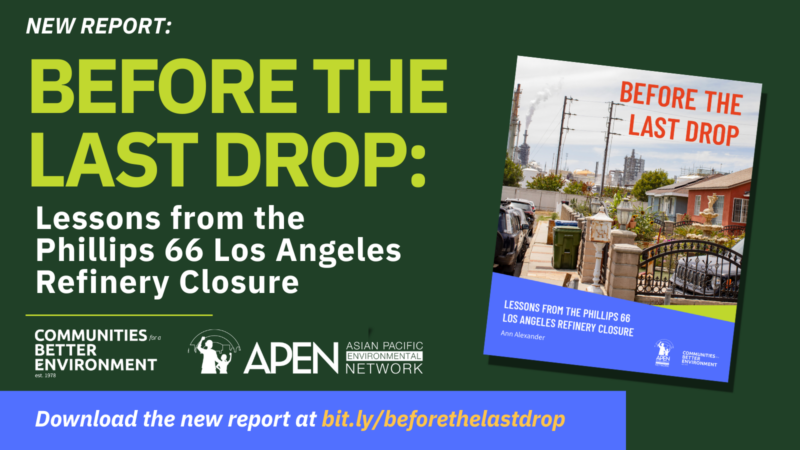
OUT NOW: New Report Provides Roadmap to Navigate “Wild West” of California Refinery Closures
“Before the Last Drop: Lessons from the Phillips 66 Los Angeles Refinery Closure” details critical gaps in state, local preparations for refinery closures
Los Angeles, CA – “Before the Last Drop” is a first-of-its-kind case study of the pending Phillips 66 Los Angeles refinery closure. Developed by environmental attorney and policy consultant Ann Alexander for Asian Pacific Environmental Network (APEN) and Communities for a Better Environment (CBE), the report draws on interviews with local policymakers, community organizers, refinery and oil policy experts, union representatives and local residents to assess existing state and local levers to regulate refinery transitions.
Read and download the full report here.
Key Findings:
- Refineries, unlike other types of energy infrastructure, have almost no end-of-life planning requirements. The resulting lack of information and financial assurances for completion of cleanup hampers community redevelopment planning, and risks inadequate cleanup funding.
- Refinery sites are massively contaminated. Cleaning up these sites will be a costly and enormous multi-year undertaking.
- Big Oil and developers’ business practices tend to cut communities and local governments out of refinery site redevelopment planning processes unless local government takes proactive steps to ensure robust community involvement.
- Failure to plan for pre-closure worker retention increases risks of understaffing and the attendant risk of refinery accidents.
- Lack of coordination among agencies and stakeholders risks chaos and lack of accountability in decommissioning, remediation, and redevelopment processes.
- Failure to prepare for refinery transitions may lead to severe economic impacts for workers and communities.
“Before the Last Drop” offers a suite of course-correcting recommendations to fix gaps in regulation, create community safety nets, strengthen refinery worker protections, prevent refinery accidents, ensure proper remediation of refinery sites, and facilitate robust community participation in site redevelopment.
“Refinery closures are very poorly regulated as compared to closures of other energy facilities – it’s really the Wild West for them,” said report author and environmental attorney, Ann Alexander. “We need more systems in place to make sure refiners who have been profiting for decades from operation in our communities don’t leave behind a trail of environmental and economic wreckage when they walk away.”
California refinery closures are expected to accelerate as Californians use less gasoline than ever, consistent with national and worldwide trends. In addition to the closure of the Phillips 66 refinery, the Valero refinery in Benicia is anticipated to close in April of next year, following the significant downsizing of the Marathon Martinez refinery after it ceased refining petroleum in 2020.
Idling has begun at the Phillips 66 Wilmington facility, where city officials are considering a proposal by developers contracted by the refinery to construct a mixed use development with shopping and recreational facilities, as well as an e-commerce fulfillment center. Any such redevelopment will depend, however, on environmental remediation of the site, where the soil and groundwater are heavily contaminated following more than a century of refinery operation, mostly prior to the advent of modern environmental laws.
The risks of a shoddy cleanup are well-documented: the announcement of the Phillips 66 closure has reminded residents of the Carousel tragedy, where families living on an improperly remediated Shell oil tank farm developed terminal cancers and other severe illnesses.
“We’re counting on the Water Board to exercise a firm hand to ensure that Phillips 66 completes a prompt and thorough cleanup of the toxic mess they’ve created, and doesn’t saddle our community with it. Frontline residents have breathed toxic pollution for generations. Now, our families must be included in the redevelopment planning for the Phillips 66 site,” said Alicia Rivera, Wilmington organizer with Communities for a Better Environment. “We’ve endured the asthma, sickness, and death linked to refinery contamination. We’re owed at least this much.”
Refinery communities have urged lawmakers across the state to take a proactive approach to refinery closures, citing the example of the City of Carson’s efforts to use its local-level zoning and planning tools to wrest back community input in the redevelopment of the Phillips 66 Carson facility.
“We’re hopeful that the Cities of Carson and Los Angeles, and the regional Water Board can lead the way for other cities in demonstrating what fair, timely, and thorough cleanup and redevelopment can look like.” said Seng So, Organizing Director with APEN Los Angeles. “The community is tired of being poisoned: they’re glad for the end to this toxic era, but they demand some real advance planning from the state for workers and communities. Phillips 66 isn’t the first refinery to close its doors this decade and it won’t be the last.”
Immediately following the announced closure, the City of Carson voted to implement detailed planning requirements for shuttered refinery sites. And at a September meeting, the Carson City Council voted unanimously to create a taskforce including regulators and residents to help guide site redevelopment.
Wilmington and Carson residents now look to respective City planning commissions, regional Water Board, and state lawmakers to implement core recommendations.
Read and download the full report here.
######